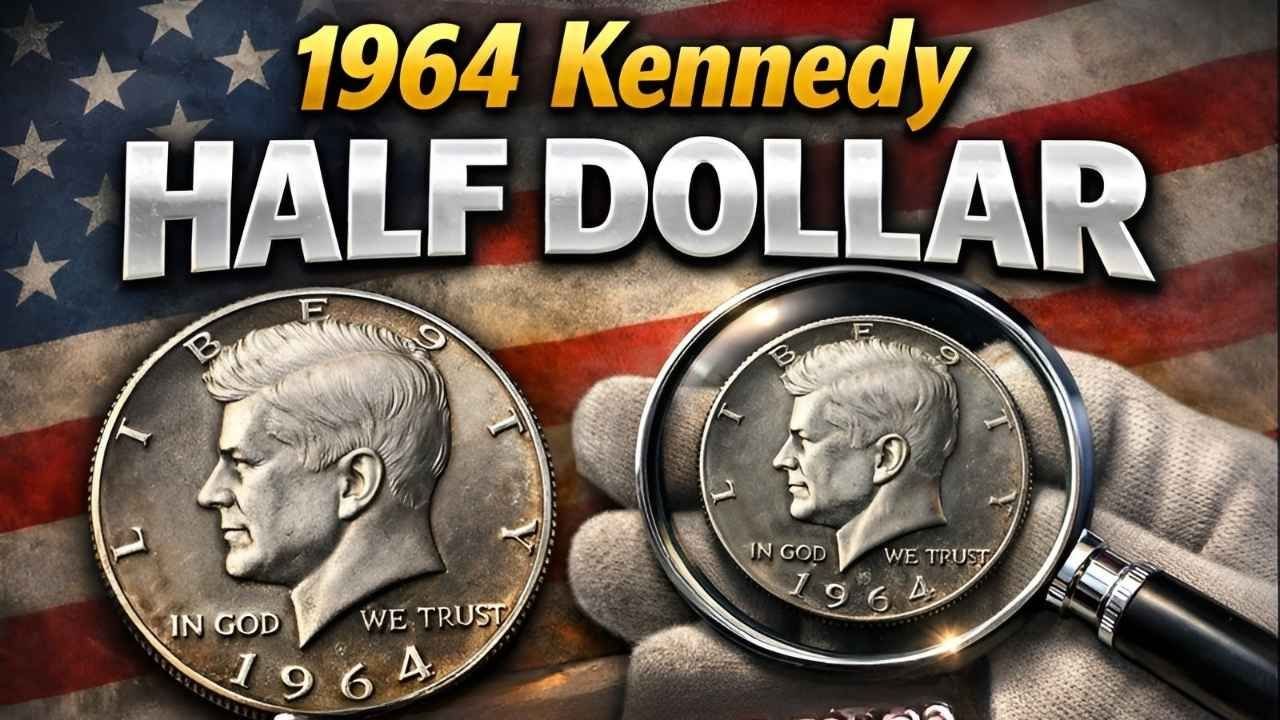
Few coins command the emotional resonance, historical gravity, and collector demand of the 1964 Kennedy half dollar. More than six decades after its release, the recent rediscovery of another pristine example has reignited fascination across the numismatic world. Found carefully preserved within an old private collection, the coin is now being described as a rare treasure potentially worth a fortune. Its reemergence underscores why the 1964 Kennedy half dollar remains one of the most iconic and closely watched coins in modern American history.
The Birth of an American Icon
The Kennedy half dollar was introduced in 1964 as a national tribute following the assassination of President John F. Kennedy in November 1963. The U.S. Mint moved with unprecedented speed, approving a new design and bringing it into production within months. The public response was immediate and overwhelming. Americans viewed the coin not merely as currency, but as a tangible memorial to a president whose legacy was still raw and deeply felt.
The obverse features a dignified profile of President Kennedy, designed to convey optimism and resolve. The reverse displays the presidential seal, complete with an eagle, shield, and olive branch, reinforcing themes of unity and national strength. From the moment it entered circulation, the Kennedy half dollar became a symbol of remembrance rather than a coin meant to be spent.
Why the 1964 Kennedy Half Dollar Is Unique
What sets the 1964 Kennedy half dollar apart from all subsequent issues is its composition. It was the only year the coin was struck in 90 percent silver for general circulation. Rising silver prices and hoarding concerns soon forced the U.S. Mint to reduce silver content in later years, making the 1964 issue permanently distinctive.
This high silver content, combined with its historical context, has ensured enduring demand. Even heavily circulated examples carry intrinsic value due to their silver weight. Coins preserved in exceptional condition, however, exist in a completely different category, where scarcity and collector competition can push values dramatically higher.
Rediscovery and Its Impact on Value
When a coin like the 1964 Kennedy half dollar is rediscovered after decades of obscurity, its value depends on several intersecting factors. Condition is the most influential. Coins that show sharp details, strong luster, and minimal contact marks can command premiums far above typical market levels.
Provenance also matters. Coins that emerge from old collections or estates often carry a sense of authenticity and untouched preservation that collectors find compelling. In some cases, rediscovered coins reveal proof-like qualities or rare strike characteristics that were previously undocumented, further elevating their appeal.
Mint Marks and Their Influence
Mint marks play a crucial role in determining desirability. In 1964, Kennedy half dollars were produced in Philadelphia and Denver. Philadelphia coins bear no mint mark, while Denver issues are marked with a “D.”
Denver-minted 1964 Kennedy half dollars are especially sought after due to lower production numbers compared to Philadelphia. When combined with superior condition, a 1964-D coin can achieve significantly higher valuations. Collectors scrutinize mint marks closely, as even subtle differences can translate into major price variations.
Condition, Grading, and Certification
Professional grading is essential in today’s collector market. Third-party grading services evaluate coins on a standardized scale, taking into account surface preservation, strike quality, luster, and overall eye appeal. A 1964 Kennedy half dollar graded in top-tier mint state can be worth many times more than an ungraded counterpart.
Certification provides confidence to buyers and sellers alike. For rediscovered coins, grading often becomes the defining moment that confirms whether a coin is simply valuable or truly exceptional. In high-grade examples, even small improvements in grade can result in dramatic increases in market value.
Historical Patterns of Rediscovered Coins
The rediscovery of valuable coins is a recurring theme in numismatic history. From rare cents pulled from circulation to gold coins uncovered in forgotten safes, many legendary pieces were once ordinary objects overlooked for decades. These stories persist because they challenge assumptions about value and remind collectors that remarkable artifacts often hide in plain sight.
The 1964 Kennedy half dollar fits squarely within this tradition. Its widespread initial distribution makes rediscovery plausible, while its silver content and historical importance ensure lasting relevance. Each new find reinforces the idea that time can transform everyday currency into a prized collectible.
Market Demand and Collector Psychology
The market for Kennedy half dollars remains strong, driven by a combination of nostalgia, historical significance, and tangible precious metal value. Auctions frequently attract competitive bidding, especially when high-grade or unusual examples appear. Stories of rediscovered coins often amplify demand, inspiring collectors to reexamine their own holdings.
Psychologically, the appeal is powerful. The notion that a familiar coin could be worth a fortune taps into universal themes of discovery and hidden potential. For collectors, ownership represents more than financial return. It signifies knowledge, patience, and participation in a shared cultural narrative.
Lessons for Collectors and the Public
The renewed attention surrounding the 1964 Kennedy half dollar offers important lessons. First, preservation matters. Coins stored carefully for decades often outperform those exposed to circulation. Second, education is essential. Understanding mint marks, composition, and grading standards can mean the difference between overlooking value and recognizing it.
Finally, curiosity plays a role. Many rediscoveries occur because someone took the time to look closely at what they already owned. In a world increasingly dominated by digital transactions, physical coins remain one of the few everyday objects capable of quietly accumulating historical and financial significance.
Cultural Meaning Beyond Monetary Value
Beyond its market price, the 1964 Kennedy half dollar carries lasting cultural importance. It represents a moment of national mourning, unity, and transition. Its continued prominence in collecting circles reflects the enduring impact of President Kennedy’s legacy and the human tendency to preserve memory through tangible objects.
The coin’s rediscovery resonates not just with collectors, but with anyone drawn to history and storytelling. It reminds us that objects we hold today may one day become symbols of the past.
Conclusion
The rediscovery of a 1964 Kennedy half dollar once again captures the imagination of collectors and the public alike. Its value, whether measured in dollars or historical significance, reflects the enduring power of numismatics. Coins are more than metal and mint marks. They are time capsules, carrying emotion, memory, and meaning across generations. The 1964 Kennedy half dollar stands as a reminder that extraordinary value can emerge from the ordinary, and that some stories only reveal their worth with time.