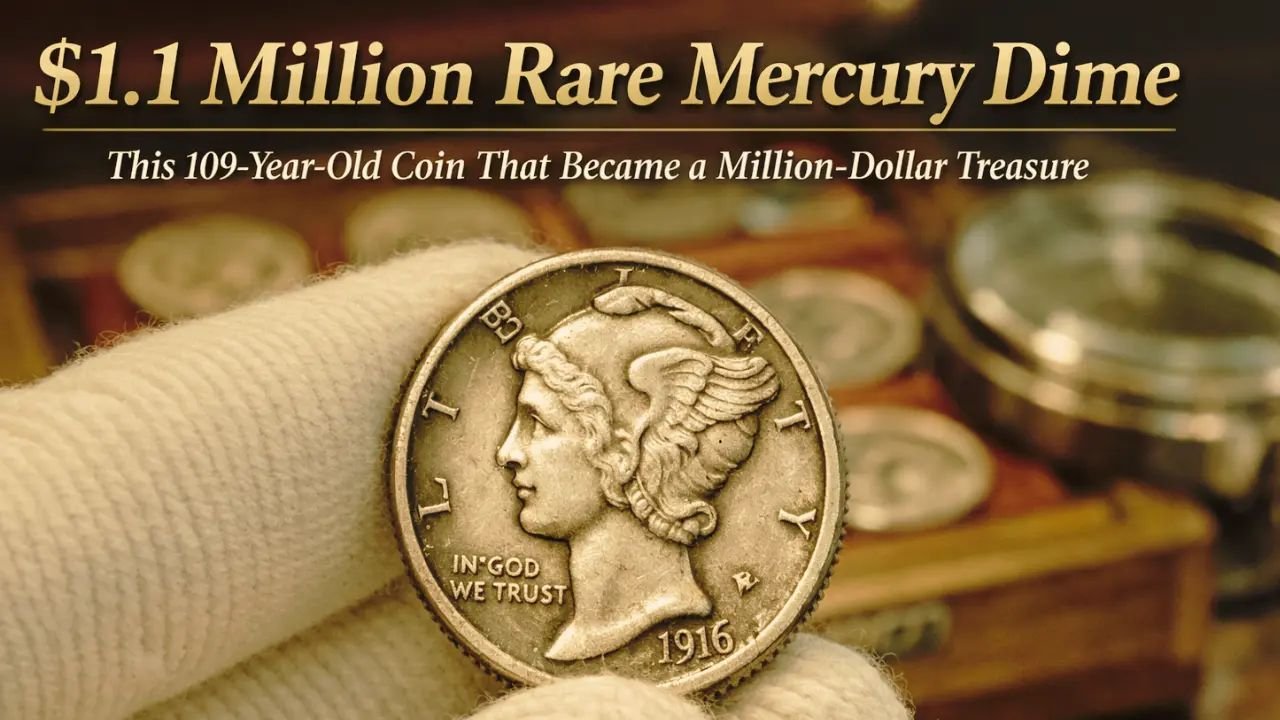
The $1.1 million Mercury dime has become a symbol of how everyday coins can sometimes conceal extraordinary value. The most famous example is the 1916-D Mercury dime, which, when in near-perfect condition, has surpassed the million-dollar mark at major auctions. Its astronomical value is not just a product of age but a combination of low mintage, historical significance, exceptional preservation, and intense collector demand. For enthusiasts, this coin embodies the ultimate “hidden treasure” story, demonstrating how ordinary objects can yield extraordinary returns.
The History Behind the Mercury Dime
The Mercury dime was introduced in 1916 as part of a redesign of U.S. silver coinage. Sculptor Adolph A. Weinman created a design depicting Liberty wearing a winged cap, symbolizing freedom of thought. Commonly called the Mercury dime due to its resemblance to the Roman god, the coin actually honors Liberty. From 1916 to 1945, more than two billion Mercury dimes were minted at Philadelphia, Denver, and San Francisco. Despite this high production, certain early issues had extremely low mintages. The 1916-D dime, produced at Denver, numbered only about 264,000 coins, creating a foundation for future rarity.
Why the 1916-D Mercury Dime Is So Valuable
The 1916-D Mercury dime is a standout within the series. With a mintage of just 264,000, it represents less than 0.2% of all Mercury dimes ever produced. Most coins were struck and circulated immediately, so very few survived in excellent condition. Today, grading services estimate that fewer than 50 coins exist in mint-state condition, with only a handful graded MS67 or higher—the level necessary for million-dollar valuations. Scarcity alone doesn’t guarantee high prices, but when paired with collector demand, it creates extraordinary market competition.
Auction Record Surpasses $1.1 Million
A pivotal moment in numismatic history occurred when a 1916-D Mercury dime, graded MS67+ with full bands, sold for over $1.1 million at a U.S. auction. The “full bands” designation indicates that the horizontal bands on the fasces are fully visible—a sign of exceptional strike quality. Coins with this designation consistently command higher prices than standard specimens. This landmark sale cemented the Mercury dime as one of the most valuable dimes ever sold, alongside legendary rarities like the 1894-S Barber dime.
Key Mercury Dimes and Approximate Values
| Year & Mint | Estimated Mintage | Typical High-Grade Value |
|---|---|---|
| 1916-D | 264,000 | Up to $1,100,000 |
| 1921 | 1,230,000 | $25,000 – $60,000 |
| 1921-D | 1,080,000 | $30,000 – $70,000 |
| 1942/41 Overdate | Unknown | $15,000 – $40,000 |
| 1919-D | 1,165,000 | $8,000 – $20,000 |
These figures highlight how subtle differences in year or mint mark can create massive value gaps within a single coin series.
The Impact of Condition and Grading
Condition is critical in determining value. Coins are graded on a 1-to-70 scale, with 70 representing perfection. A 1916-D Mercury dime in circulated condition may sell for $1,000 to $5,000, whereas a mint-state coin can reach six or seven figures. Professional grading by services like PCGS or NGC ensures authenticity and standardization, making even small differences in grade significant for pricing.
Why Collectors Pay Million-Dollar Prices
Collectors aren’t merely purchasing silver—they are acquiring history, prestige, and scarcity. Owning a million-dollar Mercury dime places a collector in an elite echelon. High-end coin collecting has also become a form of alternative investment, with rare coins appreciating steadily over decades. Coins like the Mercury dime are portable, tangible stores of value that can be passed down through generations, combining financial and historical significance.
Authentication and Provenance
Authentication involves multiple inspections, including weight, diameter, metal composition, strike characteristics, and surface details. Advanced imaging helps detect alterations or counterfeits. Once verified, the coin is sealed in a tamper-evident holder with a unique serial number. For coins valued over $1 million, this documentation is critical, as collectors demand absolute certainty before committing to a purchase.
The Broader Impact on Coin Collecting
The $1.1 million Mercury dime has reignited interest in coin collecting across the U.S. Many collectors now inspect old change jars with renewed curiosity, while dealers report increased inquiries about Mercury dimes and other early 20th-century coins. Though finding a coin worth millions is extremely rare, the story demonstrates the enduring value of preserving historical coins rather than spending them.
Final Words
The $1.1 million Mercury dime proves that even the smallest objects can hold enormous value. Its worth derives from scarcity, condition, history, and collector passion, making it far more than just a coin. It represents a piece of America’s artistic and economic heritage, and as long as collectors continue to pursue the finest examples, the Mercury dime will remain one of the most iconic and valuable dimes in U.S. history.