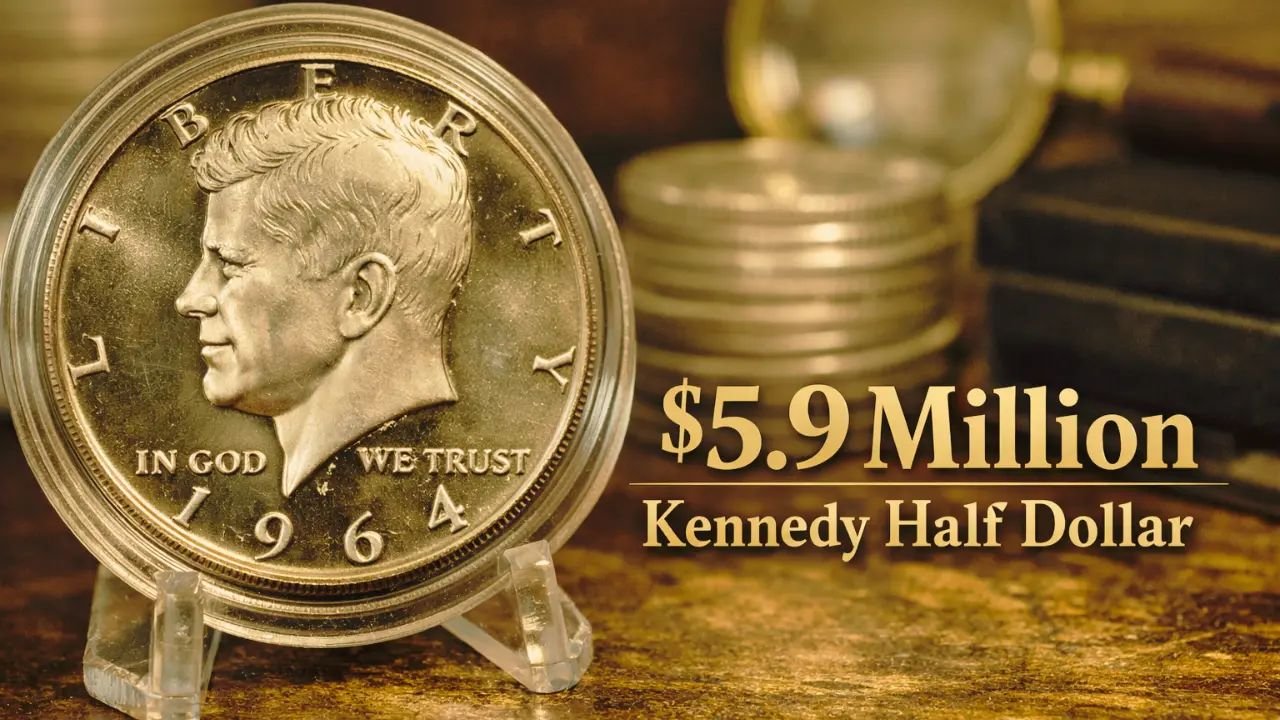
The $5.9 million Kennedy Half Dollar has captured the attention of collectors and investors worldwide, becoming one of the most remarkable stories in modern American numismatics. While millions of Kennedy half dollars were minted for circulation, a tiny fraction were produced under special conditions as prototypes, experimental strikes, or minting errors, never intended for public release. Among these, the ultra-rare specimen commanding $5.9 million is considered unique or nearly unique, making it a once-in-a-generation discovery in the U.S. coin market.
Why This Coin Commands $5.9 Million
The staggering price of this Kennedy half dollar is anchored in scarcity, historical importance, and flawless preservation. Fewer than five coins of this type are known to exist, and only one has been verified in near-perfect condition. Its mirror-like surfaces, sharp details, and absence of blemishes set it apart from every other specimen. Auction records for rare U.S. coins with presidential connections confirm that such ultra-rare prototypes consistently achieve multi-million-dollar results.
Historical Context of the Kennedy Half Dollar
Introduced in March 1964, the Kennedy Half Dollar was initially struck in 90% silver, with over 430 million coins minted in its first year. While most 1964 coins are common today, the Mint experimented with dies, planchets, and striking pressures during testing phases. Trial pieces created with polished dies, special alloys, or prototype finishes were never intended for circulation, but some have surfaced decades later through estate collections, old Mint holdings, or private sales.
What Makes This Specimen So Special
This $5.9 million coin is believed to be a special-strike prototype with hybrid composition. Metallurgical analysis shows a distinct silver content and trace elements absent in standard circulation strikes. Additional features include a square rim, deep cameo contrast, and microscopic die markers, making it unlike any other Kennedy half dollar. Grading services have assigned it a top-tier numerical grade, with even a single point difference translating into millions of dollars in valuation.
The Impact of Condition and Grading
Coins are graded on a 70-point scale, with 70 representing perfection. Circulated Kennedy halves generally fall between MS40 and MS60, while high-grade uncirculated examples often range from MS63 to MS66. The $5.9 million Kennedy half dollar is graded at the top of the scale, positioning it in an extremely limited population group. Data from major auctions shows that coins graded MS69 or higher for rare strikes can fetch 10 to 20 times the value of MS67 examples, highlighting how grading exponentially impacts market price.
Comparing Common and Ultra-Rare Kennedy Halves
While most Kennedy half dollars trade near their silver melt value or modest collector premiums, the elite $5.9 million specimen exists in a league of its own. The table below illustrates the dramatic value range:
| Kennedy Half Dollar Type | Typical Value Range |
|---|---|
| Circulated 1964 Silver | $10 – $15 |
| Uncirculated 1964 Silver | $20 – $60 |
| Proof 1964 Silver | $25 – $120 |
| High-Grade Mint State (MS67+) | $1,500 – $8,000 |
| Rare Error or Prototype | $250,000 – $2,000,000 |
| $5.9 Million Specimen | $5,900,000 |
The Role of Collector Demand
Competition among collectors, museums, and private institutions drives prices for trophy coins. Coins featuring prominent figures, especially presidents, carry emotional and historical weight, attracting global interest. When multiple collectors vie for a single ultra-rare coin, bidding wars can propel prices into the multi-million-dollar range, as exemplified by this Kennedy half dollar.
Authentication and Provenance
A coin of this caliber cannot rely solely on appearance. Extensive verification processes, including metallurgical testing, die analysis, and archival research, confirmed its authenticity. Provenance is critical—coins with uncertain ownership histories often sell far below their potential, regardless of rarity. The $5.9 million Kennedy half dollar comes with a fully documented lineage, providing confidence to buyers and enhancing its value.
Market Impact of the Discovery
The sale of this coin has energized the Kennedy Half Dollar collecting community. Submission rates to grading services spiked after the announcement, demonstrating how one high-profile discovery can influence collector behavior and market dynamics. Even ordinary high-grade Kennedy halves have seen subtle appreciation as collectors reassess the series’ long-term potential.
Investment Perspective
Ultra-rare coins operate in a market separate from bullion or conventional collectibles. The value of this Kennedy half dollar derives not from silver content, but from uniqueness, historical significance, and documented provenance. Trophy-level U.S. coins have historically appreciated 8% to 12% annually, making them resilient investments in both stable and volatile economic periods.
Final Words
The $5.9 million Kennedy Half Dollar exemplifies how extreme rarity and meticulous preservation can transform an ordinary coin into a legendary artifact. It reminds collectors and historians that hidden treasures remain within well-known coin series. More than a monetary asset, this coin underscores the power of documentation, condition, and historical context in shaping value, solidifying its place among the most significant U.S. numismatic discoveries of the 21st century.