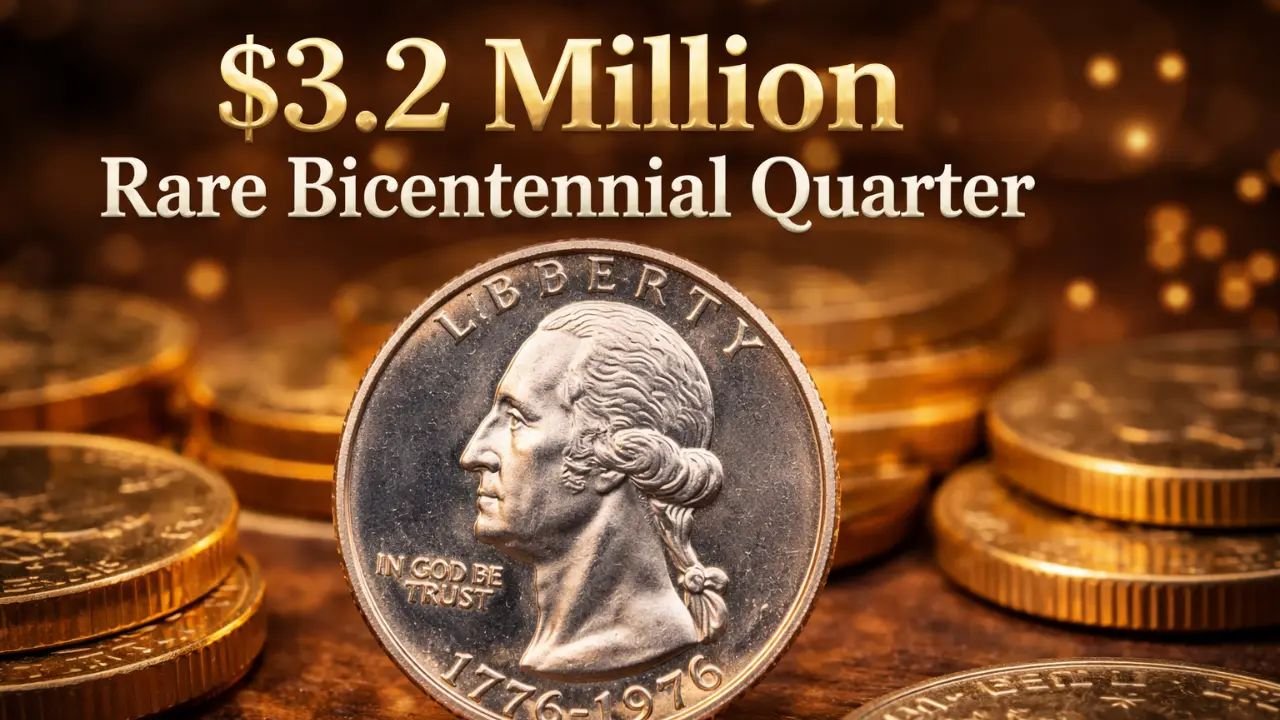
The rare $3.2 million Bicentennial Quarter has become a legend in the world of U.S. coin collecting. Issued in 1975–1976 to commemorate America’s 200th anniversary, the Bicentennial Quarter was produced in massive quantities, with over 1.6 billion coins minted across multiple facilities. Most remain worth face value or just a few dollars, but a few ultra-rare specimens, due to unique minting characteristics, experimental metals, and flawless condition, have reached valuations in the millions. These coins transform a common pocket coin into a historical and financial treasure.
The History Behind the Bicentennial Quarter
The Bicentennial Quarter was part of a special redesign program approved by Congress to honor the United States’ 200th birthday. While George Washington remained on the obverse, the reverse departed from the traditional eagle, featuring a Colonial drummer, a torch, and 13 stars representing the original colonies. Coins of this era also display two dates: “1776–1976.”
Although the vast majority of these quarters are common, certain rare varieties stand apart, primarily due to minting errors, experimental planchets, and pristine preservation. These exceptional coins are what collectors seek, often fetching extraordinary prices.
Why Some Bicentennial Quarters Are Worth Millions
Not every Bicentennial Quarter reaches the million-dollar mark. High-value coins combine rarity, historical significance, error characteristics, and perfect condition. Coins with one or two of these factors may still be valuable, but only those exhibiting all premium traits achieve the ultra-rare status that commands seven-figure prices.
The Role of Metal Composition
Most Bicentennial Quarters were struck on standard copper-nickel clad planchets, while a small portion was produced in 40% silver for collector sets. However, some specimens were struck on experimental or transitional planchets, including silver blanks intended for other denominations or special test metals never officially released. When such coins survive in near-perfect condition, their rarity and uniqueness can propel values into the millions.
Minting Errors That Increase Value
Minting mistakes are a major driver of high valuations. Double die strikes, off-metal strikes, and wrong-planchet errors make coins instantly collectible. Certain rare Bicentennial quarters display doubling on the drummer design and lettering, or were struck on blanks meant for other denominations. When these errors are significant and confirmed by experts, the coins become elite-level collectibles.
The Importance of Coin Condition
Condition is critical in determining value. A rare error in a worn coin may fetch thousands, while the same coin in flawless condition can reach seven figures. Museum-quality Bicentennial quarters are typically graded at the highest levels, with no wear, sharp details, original luster, and perfect surfaces. The $3.2 million specimen belongs to this elite category, making it virtually unrivaled.
Professional Grading and Authentication
High-priced coins require certification. Grading services evaluate weight, metal composition, strike quality, surface condition, and authenticity. Certified coins are sealed in tamper-proof holders and assigned numeric grades, providing assurance to both buyers and sellers. Professional grading is essential for establishing credibility and supporting record-breaking prices.
Collector Demand and Market Psychology
The U.S. rare coin market is driven by history, prestige, and competition. Wealthy collectors seek “trophy coins” that few can possess, and an ultra-rare Bicentennial Quarter fits that description perfectly. When multiple collectors compete for a single coin, bidding wars can push values into millions. The $3.2 million valuation exemplifies this high-stakes collector market.
How Rare Is a Million-Dollar Bicentennial Quarter?
Over a billion Bicentennial Quarters exist, yet only a handful reach million-dollar status. These coins often surface from estate collections, long-forgotten storage, or old mint holdings. Their scarcity and documented provenance make them highly desirable.
Estimated Value Range by Type
| Bicentennial Quarter Type | Estimated Value Range |
|---|---|
| Regular Circulated Coin | $0.25 – $1 |
| Uncirculated Clad Coin | $1 – $5 |
| 40% Silver Version | $10 – $50 |
| Minor Error Coin | $100 – $5,000 |
| Major Error / Rare Planchet | $50,000 – $500,000 |
| Ultra-Rare Museum-Grade Specimen | Up to $3.2 Million |
Investment Perspective
Ultra-rare coins operate in a distinct market where rarity, certification, provenance, and historical importance determine value. While not every coin appreciates significantly, historically important U.S. coins with unique characteristics have shown strong long-term growth. The rare $3.2 million Bicentennial Quarter exemplifies a niche yet highly profitable collectible investment.
Why This Coin Captivates Collectors
The notion that a common quarter could be worth millions captures the imagination. It underscores the hidden complexity of coinage and emphasizes the importance of small details. Rare Bicentennial quarters inspire collectors to examine even everyday coins, fostering appreciation for the art, history, and precision behind U.S. minting.
Final Words
The $3.2 million Bicentennial Quarter represents the perfect convergence of history, rarity, minting uniqueness, and flawless condition. While most Bicentennial Quarters remain ordinary, select specimens have achieved legendary status in the numismatic world. These coins serve as a reminder that even mass-produced items can harbor extraordinary treasures, blending historical significance with record-breaking value.