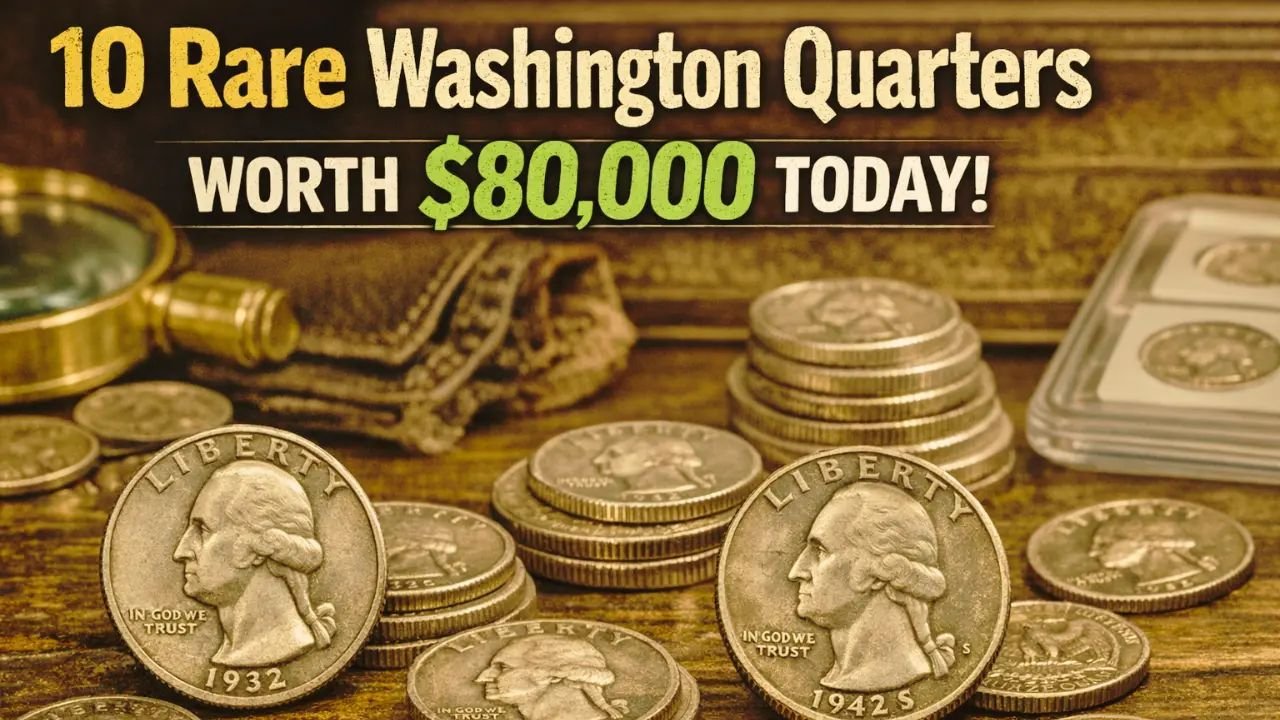
Washington quarters have been a staple of U.S. coinage since 1932, yet a select few of these coins have appreciated far beyond face value, reaching prices over $80,000. Collectors prize certain quarters not simply for age, but for low mintage, striking errors, and exceptional preservation. These coins turn ordinary pocket change into high-value collectibles and are a testament to the enduring appeal of U.S. numismatics.
1932 Washington Quarter
The inaugural Washington quarter of 1932 features George Washington on the obverse and an eagle on the reverse. Mintages were unusually low due to the Great Depression, making surviving examples rare. Coins graded MS65 or higher by professional services like PCGS or NGC can command tens of thousands of dollars. This first-year release remains a cornerstone for serious collections.
1943 Doubled Die Obverse
Some 1943 Washington quarters display a doubled die on the obverse, where lettering and numerals are unintentionally stamped twice, creating a shadow effect. This subtle error is most noticeable in the word “LIBERTY” and the date. High-quality examples of this error can fetch significant five-figure sums at auction, making it highly desirable among collectors.
1950-D Low Mintage Quarter
The 1950 Denver-minted quarter had a lower production volume, increasing scarcity. Coins graded MS66 or higher can cross $20,000, and exceptional specimens with pedigree or outstanding eye appeal have exceeded $80,000 in private sales. The combination of low mintage and excellent preservation drives demand.
1964 SMS Proof Quarter
Special Mint Set (SMS) quarters from 1964 were not intended for mass circulation and feature a distinctive satin finish. Limited distribution and careful preservation make high-grade SMS quarters extremely collectible. Exceptional specimens frequently exceed six-figure valuations in private transactions.
1976 Doubled Die Reverse
The 1976 Bicentennial quarter occasionally shows doubling on the reverse, amplifying details on the eagle and lettering. While millions were minted, only a fraction exhibit this doubling. Premium specimens have reached values as high as $80,000, demonstrating collectors’ interest in subtle but rare varieties.
1944 Silver Quarter with RPM
Repunched Mint Marks (RPM) occurred when mint workers corrected the placement of “D” or “S” mint marks, resulting in multiple impressions. High-grade quarters with these errors, especially from 1944, are highly prized. The combination of rarity, historical context, and condition can push values into the five-figure range and beyond.
1937 Doubled Die Obverse
An early series error, the 1937 doubled die obverse quarter, displays prominent doubling of letters and numerals. Certified coins in grades like MS64 or MS65 perform exceptionally well at auction, with top examples approaching or exceeding $80,000, showcasing the significance of early doubled dies.
1958 Proof Quarter with Die Break
Proof quarters from 1958 occasionally feature die cracks or breaks, creating raised lines on the coin surface. These anomalies, while unintentional, are celebrated for their uniqueness. Provenance, condition, and eye appeal can elevate these proof quarters into high-value collectibles.
1965 Washington Quarter
1965 marked a transition from silver coinage for circulating quarters. Early strikes retained by the mint or appearing in collections with anomalies can achieve significant value. Well-preserved 1965 quarters with unique characteristics are highly sought and can reach remarkable auction prices, particularly among collectors bridging silver and clad coinage eras.
1967 SMS Quarter
The 1967 Special Mint Set quarter mirrors the rarity of the 1964 SMS. Not released for circulation, these quarters have distinct finishes and are scarce in top condition. Exceptional specimens frequently surpass $80,000, demonstrating the premium placed on limited distribution coins with superior preservation.
Top Washington Quarter Values
| Year & Variety | Mint Mark | Notable Feature | Estimated Auction Range | Rarity Level |
|---|---|---|---|---|
| 1932 Washington Quarter | Various | First Year of Issue | $30,000 – $90,000+ | Extremely High |
| 1943 Doubled Die Obverse | Various | Obverse Doubling | $20,000 – $80,000+ | Very High |
| 1950-D Low Mintage | D | Low Mintage | $25,000 – $100,000+ | Extremely High |
| 1964 SMS Proof | No Mint | Special Mint Set Finish | $50,000 – $120,000+ | Very High |
| 1976 Doubled Die Reverse | No Mint | Reverse Doubling | $15,000 – $85,000+ | High |
| 1944 RPM Quarter | D/S | Repunched Mint Mark | $10,000 – $60,000+ | High |
| 1937 Doubled Die Obverse | Various | Early Doubled Die | $20,000 – $90,000+ | Very High |
| 1958 Proof with Die Break | No Mint | Die Crack Errors | $15,000 – $80,000+ | High |
| 1965 Transition Quarter | No Mint | Silver Transition Era | $10,000 – $70,000+ | Moderate to High |
| 1967 SMS Quarter | No Mint | Special Mint Set | $20,000 – $100,000+ | Very High |
Why Condition Matters
Condition often outweighs age in determining value. Coins with minimal wear and original mint luster command premium pricing. Grading by services like PCGS and NGC evaluates strike quality, surface preservation, and eye appeal, allowing collectors to confidently assess investment potential.
Certified Grading Protects Value
Professional grading ensures authenticity and provides standardized evaluation. Certified high-grade coins can see exponential value growth compared to circulated or uncertified counterparts, making grading essential for serious collectors and investors.
Final Words
The 10 rare Washington quarters worth $80,000 illustrate how scarcity, errors, and exceptional preservation drive value in coin collecting. Beyond their metal content, these coins embody history, craftsmanship, and the thrill of collecting. For U.S. collectors, they transform ordinary currency into prized historical artifacts with enduring market demand.